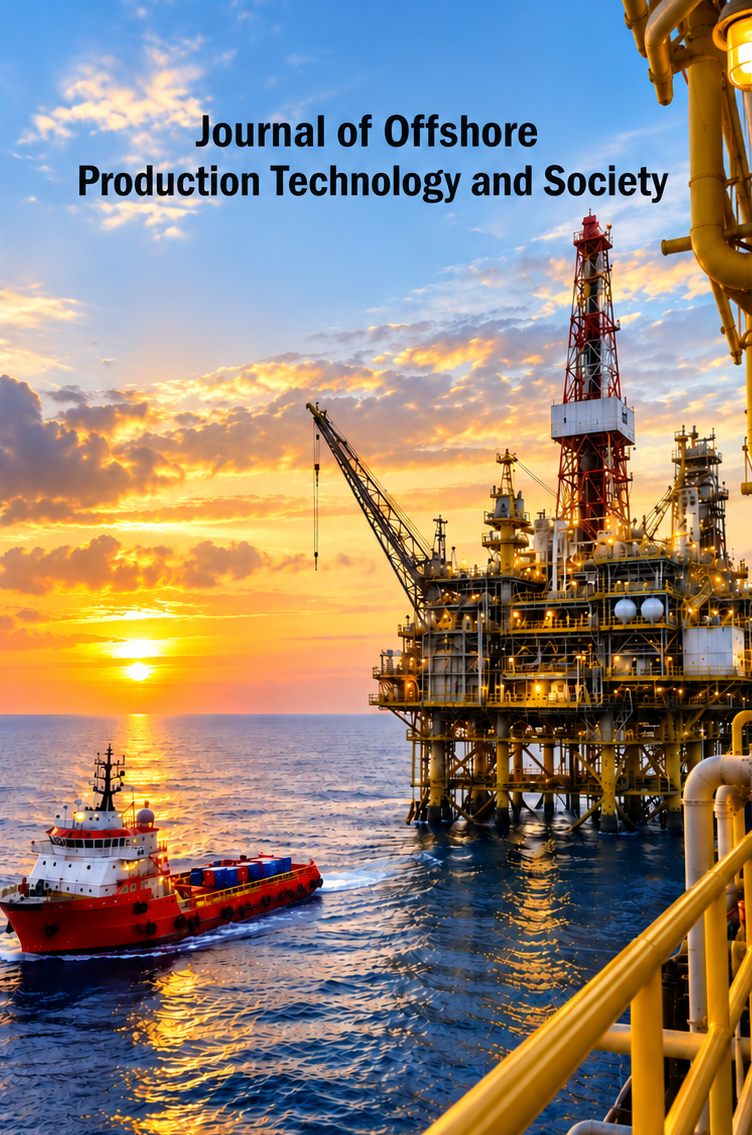
Unmanned Offshore Production Technology
Safety Opportunities and Social Consequences
Keywords:
Unmanned Facilities, Offshore Production, Automation, Occupational Safety, Workforce TransformationAbstract
The development of automation, artificial intelligence, digital sensors, and remote control systems is driving the adoption of unmanned offshore production facilities. These technologies offer opportunities to reduce workers' exposure to explosions, fires, gas leaks, extreme weather, and marine and air transportation accidents. In addition to improving safety, unmanned facilities can also reduce logistics needs and support operations in locations far from land. However, reducing the workforce at a facility does not necessarily eliminate risk. These risks can move to digital systems, ground control centers, maintenance activities, and cybersecurity. Automation also brings social consequences in the form of changing job types, new skill demands, reduced number of operational positions, and potential inequality of access to high-skilled jobs. This perspective article discusses the safety opportunities and social consequences of unmanned offshore production technologies, while criticizing an overly efficiency-centric approach. The authors argue that unmanned facilities should be developed as a system of collaboration between humans and technology. Its success is not only judged on the basis of personnel and cost reductions, but also on the level of reliability, emergency preparedness, data security, and the industry's ability to manage the workforce transition fairly.
References
[1] A. Nasser, A. Sahrab, and H. Kadhim, “Design and simulation of remote monitoring of the intelligent automatic control system in the production line,” IAES Int. J. Artif. Intell., 2024, doi: 10.11591/ijai.v13.i1.pp133-142.
[2] T. Wanasinghe, R. Gosine, B. Petersen, and P. Warrian, “Digitalization and the Future of Employment: A Case Study on the Canadian Offshore Oil and Gas Drilling Occupations,” IEEE Trans. Autom. Sci. Eng., vol. 21, pp. 1661–1681, 2024, doi: 10.1109/tase.2023.3238971.
[3] A. Mahat, M. Z. M. Salleh, and M. Takriff, “Drone Technology Improves Personnel Safety in Offshore Working Environment Via Quantitative Risk Assessment (QRA) Analysis,” J. Engineer., 2025, doi: 10.17576/jkukm-2025-37(5)-16.
[4] Q. Liu, Y. Wang, F. Zhao, C. Zheng, and J. Xie, “A Review of the Research Progress of Sensor Monitoring Technology in Harsh Engineering Environments,” Sensors (Basel)., vol. 25, 2025, doi: 10.3390/s25206308.
[5] J. Vinnem, “Assessment of risk tolerance for future autonomous offshore installations,” Saf. Sci., vol. 134, p. 105059, 2021, doi: 10.1016/j.ssci.2020.105059.
[6] M. Sukharev and M. Chupin, “Devices operability control through gas supply system mode parameter routine measurement history,” J. Process Control, 2023, doi: 10.1016/j.jprocont.2022.11.003.
[7] S. Waschull, J. A. C. Bokhorst, E. Molleman, and H. Wortmann, “Work design in future industrial production: Transforming towards cyber-physical systems,” Comput. Ind. Eng., vol. 139, p. 105679, 2020, doi: 10.1016/j.cie.2019.01.053.
[8] T. Malone, A. Planey, L. Bozovich, K. Thompson, and G. Holmes, “The economic effects of rural hospital closures.,” Health Serv. Res., 2022, doi: 10.1111/1475-6773.13965.
[9] R. Godavarthi and A. Leto, “Advanced Digital Solutions for Remote Operations and Minimally Staffed Facilities,” Day 1 Mon, May 01, 2023, 2023, doi: 10.4043/32630-ms.
[10] H. Belgacem and I. Chihi, “Toward Reliable and Intelligent Sensor Systems: A Comprehensive Study of Fault Diagnosis and Mitigation,” IEEE Sensors Rev., vol. 2, pp. 511–536, 2025, doi: 10.1109/sr.2025.3601092.
[11] B. Tekinerdoğan and Ç. Çatal, “Predictive maintenance using digital twins: A systematic literature review,” Inf. Softw. Technol., vol. 151, p. 107008, 2022, doi: 10.1016/j.infsof.2022.107008.
[12] N. Griffiths, V. Bowden, S. Wee, L. Strickland, and S. Loft, “Operator selection for human-automation teaming: The role of manual task skill in predicting automation failure intervention.,” Appl. Ergon., vol. 118, p. 104288, 2024, doi: 10.1016/j.apergo.2024.104288.
[13] E. Tenakwah and C. Watson, “Embracing the AI/automation age: preparing your workforce for humans and machines working together,” Strateg. Leadersh., 2024, doi: 10.1108/SL-05-2024-0040.
[14] P. Kolapo, N. Ogunsola, K. Komolafe, and D. Omole, “Envisioning Human–Machine Relationship Towards Mining of the Future: An Overview,” Mining, 2025, doi: 10.3390/mining5010005.
[15] F. Borghesan, M. Zagorowska, and M. Mercangöz, “Unmanned and Autonomous Systems: Future of Automation in Process and Energy Industries,” IFAC-PapersOnLine, 2022, doi: 10.1016/j.ifacol.2022.07.555.
[16] Q. Qiu, R. Li, and X. Zhao, “Failure risk management: adaptive performance control and mission abort decisions,” Risk Anal., vol. 45, pp. 421–440, 2024, doi: 10.1111/risa.16709.
[17] S. Yuan, M. Yang, and G. Reniers, “Integrated process safety and process security risk assessment of industrial cyber-physical systems in chemical plants,” Comput. Ind., vol. 155, p. 104056, 2024, doi: 10.1016/j.compind.2023.104056.
[18] M. Bouwmans, X. Lub, M. Orlowski, and T.-V. Nguyen, “Developing the digital transformation skills framework: A systematic literature review approach,” PLoS One, vol. 19, 2024, doi: 10.1371/journal.pone.0304127.
[19] I. Jeelani and M. Gheisari, “Safety challenges of UAV integration in construction: Conceptual analysis and future research roadmap,” Saf. Sci., 2021, doi: 10.1016/j.ssci.2021.105473.